

“It was a lot of fun to do this. But it was really enlightening as well,” begins vocalist John Corabi, talking about Lookin’ For Trouble – the newly released blues covers album from The Dead Daisies.
Corabi, along with guitarists Doug Aldrich and David Lowy, bassist Michael Devin, drummer Sarah Tomek, and producer Marti Frederiksen turned up the voltage on ten classic blues songs, including tracks by Muddy Waters, Albert King, and Howlin’ Wolf, to name a few.
“A few people have commented, ‘Well, you kind of did the obvious tunes,’” admits Corabi. “But these are the songs that were… ‘Crossroads’ for example. I didn’t know who Robert Johnson was when I was a kid. I had no idea. But Cream played me the song, and for the longest time, I thought it was a Cream song. Then Skynyrd covered it on the One More From The Road record, and I just thought they covered a Cream song. Then you get this beautiful thing called Google, and YouTube, and you start researching some of these old songs that you grew up listening to. And you find out that these songs really influenced a lot of different people. Not just even in the rock world; across the board. To me, now, after doing this record, I’ve come to the realization that blues is the seed, and then the tree grew; and then the tree grew branches. All those branches are like, for an analogy, are all the different types of music we listen to. Whether it be country, pop, rock, metal, whatever. It all stems from that tree. The only thing that doesn’t come from that tree is classical music. All the rest – the blues is the thing that started it all.”
Environment was key to what is heard on Lookin’ For Trouble. The Dead Daisies recorded these ten blues songs at FAME [Florence Alabama Music Enterprises] Studios in Muscle Shoals, Alabama. Truly an iconic setting, legends like Aretha Franklin, Wilson Pickett and Etta James all recorded music on this hallowed ground. During the 20-minute accompanying documentary (which can be seen below), the viewer really gets a feel for what the band was experiencing within those walls. It’s similar to the first time you step foot inside The Whisky A Go Go in West Hollywood, California and realize everybody who’s played that stage!
“That’s the thing. Call me whatever you want – musician, rock star; whatever. At the end of the day, I’m still that 14, 15-year-old kid that sits in his room; I’m fascinated by the history of things,” says Corabi. “Clearly, my first time walking on – like you just said, The Whisky stage. I was like, Oh my God! The Doors were discovered here. Three Dog Night was the house band here. This is the place where Chicago wrote ‘25 Or 6 To 4’. Zeppelin, on their first tour, played on this stage. Just being in that room… there’s one thing in that video – to me, it’s hilarious – Michael Devin (bassist) is walking around the room, and he goes, ‘There’s a 90% chance I’m standing right where Duane Allman stood.’ And the guy from FAME goes, ‘There’s 100% chance you’re standing on one of the places that Duane slept.’ Then he went on to tell us – I was so upset it wasn’t in the documentary. He tells us – and I think it was in the documentary that Netflix did as well. You don’t realize that Duane Allman was just so into that whole sound they had there. He literally, I think they said he got on a motorcycle and he pitched a tent out in front of the FAME building. And all the Swampers guys came in and they’re like, ‘There’s this hippie kid sleeping in the parking lot. He says he’s a guitar player.’ So, they brought him in, and they were like, ‘Fuck, this kid is really good!’ He wound up doing the guitar solo on Wilson Pickett’s version of ‘Hey Jude’ (in 1968), which historically, people would go, ‘Man, that guitar solo is just otherworldly.’”
“You’re in this environment and you’re looking… I remember singing – I forget what song I was doing. But we had kind of arranged the song, and we were tracking this shit live off the floor. I remember, I had my motorhome with me, and I had gone out to my motorhome, I poured myself a whiskey and I came back in. I was literally sitting there singing on this old Ribbon mic or some shit, and I just happened to look out. I’m holding the whiskey, and I’ve got the lyrics in front of me. I look out and there’s a picture of Aretha Franklin, on the same mic, with a whiskey in her hand, and a cigarette. I’m like, this is insane! The whole experience was awesome. And the people down at FAME were just – Rick (Hall)’s wife still runs the place; the museum and all the stuff they have there. You can see his office where he was making his deals, and all this other kind of stuff. We had this assistant engineer working with us, Spencer, who’s awesome. I only live like two hours – I was just telling my wife we’ve got to go down there again and not be musicians in the studio. Let’s go do the tour and hear what they tell everybody; get even more history. We’ll have dinner, we’ll stay over and then ride back home on the motorcycle. I want to do a trip down there again just to take it all in.”

Evan Frederiksen, the son of producer Marti Frederiksen, played drums on Light ‘Em Up, the previous studio album from The Dead Daisies, released in 2024. However, Evan’s not behind the kit on Lookin’ For Trouble. Instead, it’s Sarah Tomek (Steven Tyler Band, Samantha Fish) on drums. Corabi reveals how they came to work with her and what it like.
“You’ve got to remember, there was this whole glitch in our schedule. We had studio time booked in Nashville, and right before we started, our manager called me and he said, ‘Hey dude, Brian (Tichy, drummer) can’t do the record.’ I don’t know what happened there, but Brian had committed to doing some stuff with Gene Simmons (from KISS). So, our manager’s like, ‘Who do we know in Nashville?’ Well, Tommy Clufetos, who has been in our orbit since I was in the band in ’15. I said, ‘Tommy lives here now. Marti plays drums, Evan plays drums, my son plays drums. Marti’s got his band, Loving Mary, that backed Steven (Tyler from Aerosmith).’ And I had done some stuff with Sarah on the side, like little jams here in town. We just had everybody in the studio. So, when we went down to Muscle Shoals, we just took everybody with us. Evan was pulling double duty cause he not only plays the drums, he’s a great musician. He plays guitar, bass, keyboards; but he’s also a whiz kid on the Pro Tools stuff. A lot of our stuff that we’ve recorded, even in the past, Evan was kind of assisting Marti. So, we just packed up and went south, and Sarah just had that thing for the blues. I still sit and listen to some of the stuff that she did on that record, and I’m like, ‘God damn it! She’s got groove.’”
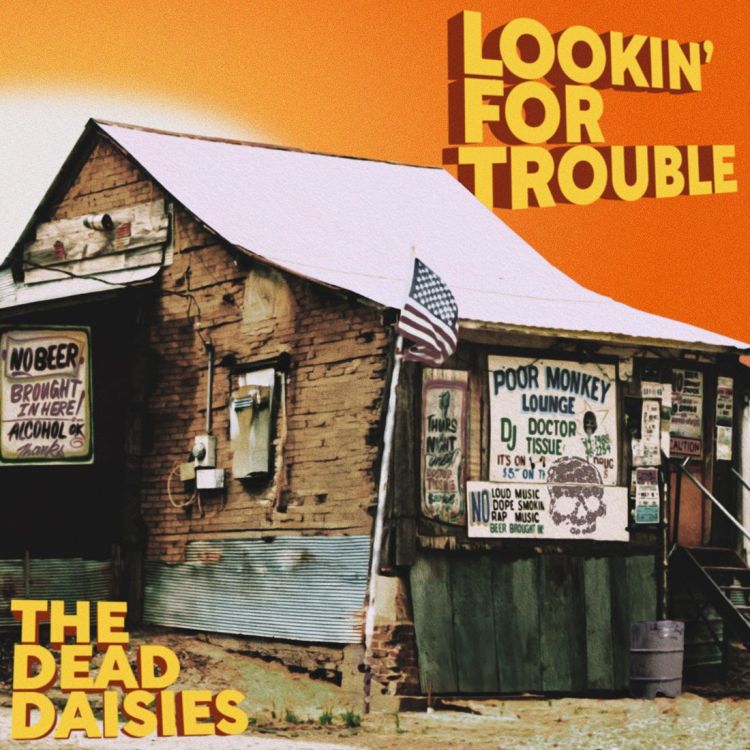
The Lookin’ For Trouble cover art depicts a juke joint named Poor Monkey Lounge. Corabi reveals the origins of that image. “The Poor Monkey Lounge is in Marigold, Mississippi and it is an actual juke joint from back in the day, a historical landmark. So, it’s an actual place. Oddly enough, I remember when they were putting the album cover together, they said they had found a really cool, old juke joint.”
The Dead Daisies skull logo has been added to the exterior of Poor Monkey Lounge, but was DJ Doctor Tissue actually the guy who spun records in there? “I’m guessing that somewhere they found a photo of that place and just super-imposed our logo on it. I’m looking at it right now on Google, and it says it was founded in the late ‘50s / early ‘60s and it was one of the last rural juke joints in the Mississippi Delta. And that was the thing, none of us are blues aficionados; we don’t claim to be. It’s so weird and random how this kind of all came together. It was really a happy little accident. But at the end of the day, when we were researching this stuff, it was such an enlightening, eye-opening experience that we would just sit around and talk about how a lot of these guys didn’t make a lot of money. They would play for a couple bucks, a free bar tab and food. It was the love of doing it. But the whole history of everything… we’re sitting here going, we were enlightened, and maybe there’s somebody out there that doesn’t realize that ‘Crossroads’ wasn’t a Cream song or a Lynyrd Skynyrd song and will dive deep into Robert Johnson. Then they can see – Robert Johnson, to me, is probably the guy that was the most covered, with his songs. The history and the stories are so unbelievably insane! So, we’re hoping that we can maybe teach, or enlighten people to the history of this unfortunately under-appreciated artform.”
The aforementioned 20-minute documentary alludes to the inception of the album title. It says, “You might say that to create a blues album would be Lookin’ For Trouble.” According to Corabi, “Honestly, we were just trying to find something that really summed it all up. I think (bassist) Michael Devin was actually the one that came up with the title. If you go back historically, you read about it, it was an African American artform; but under-appreciated. White America was not really ready for this kind of stuff. These juke joints were always on the other side of the tracks, away from White America. They were these taboo places where ‘Those Black folks get together and sing and dance and have sex. They’re using lewd language.’ So, Michael Devin’s like, ‘We should just call it Lookin’ For Trouble’, cause that’s what it is. It was the Devil’s music. People referred to juke joints as, ‘That’s where the troublemakers hang out.’”
Obviously, technology in both instruments and recording studios has come a long way since these blues songs were originally created; they range in date from 1937 to 1971. Corabi and co. managed to make familiar music sound fresh. How much thought went into the re-arrangement of the songs to make them fit within The Dead Daisies style?
“Well, we had a motto when we were doing this record. And one of the songs we kept looking at – for lack of a better term, the blueprint on how to do this – was, even Marti said, ‘Dude, it takes zero talent to sit down and learn Skynyrd’s version of “Crossroads” and just do that. Let’s come up with something cool and make it our own.’ We used Zeppelin as a blueprint. Every song we picked, we’d go, ‘What would Zeppelin do?’ And the song we used as the blueprint was ‘When The Levee Breaks’. I don’t know if you know the history of that song? I believe Jimmy Page is credited as a writer, but it’s Memphis Minnie, and this guy Kansas Joe McCoy, who wrote that song in 1929 about a horrific flood of the Mississippi River that wiped out thousands of barns and businesses, and killed a bunch of people in 1927. The genius of what Zeppelin did is, they took the melody and the lyrics, and then just created this really haunting, powerful, epic to go underneath of that as a bed. Not that we’re even in the same ballpark as Zeppelin, but it was like, how can we do to this song what Zeppelin did to ‘When The Levee Breaks’?” We just took every song and said, ‘Alright, Doug (Aldrich, guitarist) – you do what you do. Marti (Frederiksen, producer) – you do what you do. We just sat there and arranged them. We got it to where we knew what we were doing, and then we just tracked it live off the floor!”

As mentioned, other artists have covered these blues songs before, and we’ve been talking about “Crossroads” quite a bit. Last year, Slash covered “Crossroads”, with Gary Clark Jr. on vocals, for his solo album, Orgy Of The Damned. Two very different takes on an iconic song. The Dead Daisies’ version is three and a half minutes. Slash’s rendition is five and a half minutes; two minutes longer. The Daisies’ mix is in your face, whereas Slash’s is laid back with an extended sultry guitar solo.
“Well, I’ve got to be honest with you. It’s hilarious because, I don’t know if the music industry knew that Slash was doing that record. Or that Gibson Guitars had a fucking record label. I found out, I was like – fuck! Cause we had just finished recording Light ‘Em Up and the blues record. Then all of a sudden… I have a little ritual. Every morning at like 6:30 or 7 o’clock, cause I have dogs that – apparently, I don’t need an alarm clock, they wake me every morning. I come out, I make coffee, I throw a ball, have my morning breakfast cigarette, and I check my emails, I look at Google and YouTube. It just happened that I opened my phone and it’s like, ‘Slash’s new blues record on Gibson.’ So, I clicked on it, I read the tracklisting – ‘Motherfucker! Are you shitting me?’ Now it’s going to look like we jumped on a bandwagon. I immediately sent an email to my manager. I go, ‘Slash just did a fucking blues record!’ He’s like, ‘Ah, whatever, don’t worry about it.’ I have listened to Slash’s record since, and I think he took a more traditional… he went deep and used the amps that they were using. He really went old school with that record, which is awesome. But again, the beauty of the blues is Slash does his interpretation of it. And he painted this amazing landscape, and then we come out of nowhere and do like a Dali. But I wasn’t happy about that blues record by Slash for a second. It was funny. I’m like, ‘God damn it. Just our luck.’”
Many years ago, John Corabi used to sing in an Aerosmith tribute band. Both Aerosmith (in 1973) and Ratt (in 1983) have recorded their own versions of “Walking The Dog” by Rufus Thomas. “My biggest concern was… and I fucked up actually; I just caught it. I didn’t realize I did it. But I kind of threw a Tyler-ism in the last verse of ‘Walking The Dog’. I must have went back to my Aerosmith tribute days, but I was trying to not sing it like Steven Tyler. Even Marti was laughing, he goes, ‘Alright dude, try and be you.’ It’s the last verse, I kind of slipped into that Tyler thing for a minute and I go, ‘Little biddy, biddy white shelves.’ But the way I phrased it was like Tyler.”
“You know what dude, again, regardless of whatever, all I can say is I recorded at FAME. We did a blues record, a tip of the hat to all these fucking guys that are just incredibly talented. Even the guys like Aerosmith, Zeppelin and Foghat, all those guys that covered the songs, Cream, Skynyrd, they taught us about these other guys that were incredibly talented, started the whole scene. It was just a fun, enlightening experience for all of us. It was a blast! And I got to hang out with my buddies. I took my motorhome down there. They had hotel rooms; I slept on the motorhome every night. I had a fucking killer time. They showed up every day at like 9 or 10 o’clock in the morning. I had already gone to Dunkin’ Donuts; I just ordered them a dozen donuts every day and coffee. We just hung out and we had a blast. It was awesome!”

“The Thrill Is Gone” by B.B. King is sequenced perfectly. Lookin’ For Trouble is pretty high energy until that point, and it brings the tempo down. It makes you close your eyes; you get lost in the song. It’s like a smoky bar-room scene from a movie. It’s such a great placement and terrific rendition of that track.
“That’s cool man, I appreciate it. That one was hard because it’s such… it would be like – there’s a million Zeppelin songs you could do. And you could probably rearrange them and make them your own, but you can’t do it to ‘Stairway To Heaven’. You can’t do it to ‘Bohemian Rhapsody’ (by Queen). But I think what we did is we did try to do a different… I don’t know how to explain it. It was like a little bit of a different feel on the time signature. I don’t know theory, but Doug says it’s like a 6/8 time signature – whatever that means. But it was just like you said – smoky. And it’s funny you said that because my wife loves that version of the song. She said, ‘When I hear it, I feel like I should light a joint, lay back, and just take it all in. And I don’t even smoke.’”
When listening to the songs on Lookin’ For Trouble, a juke box or old radio comes to mind, certainly not Spotify or Apple Music. “I hope people enjoy it, and I hope it makes people take a deep dive into some of these artists,” states Corabi.
If you do that dive, you’ll learn that B.B. King didn’t write “The Thrill Is Gone”. It was written by Roy Hawkins and Rick Darnell in 1951, way before 1971 when B.B. King won a Grammy Award for his rendition. “It might have been a regional hit for them (Hawkins and Darnell) earlier. Then B.B. put his spin on it, brought his girlfriend ‘Lucielle’ to the party. It was Best Male Vocal R&B song. It’s just such a classic tune. That one was like the ‘Stairway To Heaven’ of the record. Like, how do we do this? Our thing was, keep the integrity of the song, but make it our own. I mean, we could have done a punk version, but I don’t think it would have the same impact.”
“That was a bit of a task. Doug (Aldrich, guitarist), still to this day, he’s like, ‘Ah dude, there’s so many other things I could have played. I could have done this riff differently, or that riff.’ I’m like, don’t overthink it. It’s a moment in time. It sounds great, and it’s a live recording off the floor. Even Doug will tell you, he wasn’t happy with some part of the song he played. He felt he could do it better. But then he went home, and he thought about it. He listened to it some more, and he went back in the next day. Marti (Frederiksen, producer) said, ‘What do you want to do?’ And Doug said, ‘I don’t know if I can recreate that vibe we had going in the studio, so just leave it.’ Even me, I listened to it and it’s one of those things, we’re all our own worst critics. I listen to it now and think, I could have done that part better. But it was truly just, we arranged it, figured it out, and then Marti’s like, ‘Okay, let’s record.’ I don’t even know if we did more than one take. We just played it, and if there was anything else that needed to be added, like organ or whatever, Marti or somebody went out and played it, and we put it on. It was just the five of us in a room. We tracked it, we went back in and listened to it, added what needed to be added, and put it to bed.”
(Photos courtesy of David Pear)
The post INTERVIEW: THE DEAD DAISIES – “Blues Is The Seed, Then The Tree Grew” appeared first on BraveWords - Where Music Lives.
Continue reading...
Corabi, along with guitarists Doug Aldrich and David Lowy, bassist Michael Devin, drummer Sarah Tomek, and producer Marti Frederiksen turned up the voltage on ten classic blues songs, including tracks by Muddy Waters, Albert King, and Howlin’ Wolf, to name a few.
“A few people have commented, ‘Well, you kind of did the obvious tunes,’” admits Corabi. “But these are the songs that were… ‘Crossroads’ for example. I didn’t know who Robert Johnson was when I was a kid. I had no idea. But Cream played me the song, and for the longest time, I thought it was a Cream song. Then Skynyrd covered it on the One More From The Road record, and I just thought they covered a Cream song. Then you get this beautiful thing called Google, and YouTube, and you start researching some of these old songs that you grew up listening to. And you find out that these songs really influenced a lot of different people. Not just even in the rock world; across the board. To me, now, after doing this record, I’ve come to the realization that blues is the seed, and then the tree grew; and then the tree grew branches. All those branches are like, for an analogy, are all the different types of music we listen to. Whether it be country, pop, rock, metal, whatever. It all stems from that tree. The only thing that doesn’t come from that tree is classical music. All the rest – the blues is the thing that started it all.”
Environment was key to what is heard on Lookin’ For Trouble. The Dead Daisies recorded these ten blues songs at FAME [Florence Alabama Music Enterprises] Studios in Muscle Shoals, Alabama. Truly an iconic setting, legends like Aretha Franklin, Wilson Pickett and Etta James all recorded music on this hallowed ground. During the 20-minute accompanying documentary (which can be seen below), the viewer really gets a feel for what the band was experiencing within those walls. It’s similar to the first time you step foot inside The Whisky A Go Go in West Hollywood, California and realize everybody who’s played that stage!
“That’s the thing. Call me whatever you want – musician, rock star; whatever. At the end of the day, I’m still that 14, 15-year-old kid that sits in his room; I’m fascinated by the history of things,” says Corabi. “Clearly, my first time walking on – like you just said, The Whisky stage. I was like, Oh my God! The Doors were discovered here. Three Dog Night was the house band here. This is the place where Chicago wrote ‘25 Or 6 To 4’. Zeppelin, on their first tour, played on this stage. Just being in that room… there’s one thing in that video – to me, it’s hilarious – Michael Devin (bassist) is walking around the room, and he goes, ‘There’s a 90% chance I’m standing right where Duane Allman stood.’ And the guy from FAME goes, ‘There’s 100% chance you’re standing on one of the places that Duane slept.’ Then he went on to tell us – I was so upset it wasn’t in the documentary. He tells us – and I think it was in the documentary that Netflix did as well. You don’t realize that Duane Allman was just so into that whole sound they had there. He literally, I think they said he got on a motorcycle and he pitched a tent out in front of the FAME building. And all the Swampers guys came in and they’re like, ‘There’s this hippie kid sleeping in the parking lot. He says he’s a guitar player.’ So, they brought him in, and they were like, ‘Fuck, this kid is really good!’ He wound up doing the guitar solo on Wilson Pickett’s version of ‘Hey Jude’ (in 1968), which historically, people would go, ‘Man, that guitar solo is just otherworldly.’”
“You’re in this environment and you’re looking… I remember singing – I forget what song I was doing. But we had kind of arranged the song, and we were tracking this shit live off the floor. I remember, I had my motorhome with me, and I had gone out to my motorhome, I poured myself a whiskey and I came back in. I was literally sitting there singing on this old Ribbon mic or some shit, and I just happened to look out. I’m holding the whiskey, and I’ve got the lyrics in front of me. I look out and there’s a picture of Aretha Franklin, on the same mic, with a whiskey in her hand, and a cigarette. I’m like, this is insane! The whole experience was awesome. And the people down at FAME were just – Rick (Hall)’s wife still runs the place; the museum and all the stuff they have there. You can see his office where he was making his deals, and all this other kind of stuff. We had this assistant engineer working with us, Spencer, who’s awesome. I only live like two hours – I was just telling my wife we’ve got to go down there again and not be musicians in the studio. Let’s go do the tour and hear what they tell everybody; get even more history. We’ll have dinner, we’ll stay over and then ride back home on the motorcycle. I want to do a trip down there again just to take it all in.”
Evan Frederiksen, the son of producer Marti Frederiksen, played drums on Light ‘Em Up, the previous studio album from The Dead Daisies, released in 2024. However, Evan’s not behind the kit on Lookin’ For Trouble. Instead, it’s Sarah Tomek (Steven Tyler Band, Samantha Fish) on drums. Corabi reveals how they came to work with her and what it like.
“You’ve got to remember, there was this whole glitch in our schedule. We had studio time booked in Nashville, and right before we started, our manager called me and he said, ‘Hey dude, Brian (Tichy, drummer) can’t do the record.’ I don’t know what happened there, but Brian had committed to doing some stuff with Gene Simmons (from KISS). So, our manager’s like, ‘Who do we know in Nashville?’ Well, Tommy Clufetos, who has been in our orbit since I was in the band in ’15. I said, ‘Tommy lives here now. Marti plays drums, Evan plays drums, my son plays drums. Marti’s got his band, Loving Mary, that backed Steven (Tyler from Aerosmith).’ And I had done some stuff with Sarah on the side, like little jams here in town. We just had everybody in the studio. So, when we went down to Muscle Shoals, we just took everybody with us. Evan was pulling double duty cause he not only plays the drums, he’s a great musician. He plays guitar, bass, keyboards; but he’s also a whiz kid on the Pro Tools stuff. A lot of our stuff that we’ve recorded, even in the past, Evan was kind of assisting Marti. So, we just packed up and went south, and Sarah just had that thing for the blues. I still sit and listen to some of the stuff that she did on that record, and I’m like, ‘God damn it! She’s got groove.’”
The Lookin’ For Trouble cover art depicts a juke joint named Poor Monkey Lounge. Corabi reveals the origins of that image. “The Poor Monkey Lounge is in Marigold, Mississippi and it is an actual juke joint from back in the day, a historical landmark. So, it’s an actual place. Oddly enough, I remember when they were putting the album cover together, they said they had found a really cool, old juke joint.”
The Dead Daisies skull logo has been added to the exterior of Poor Monkey Lounge, but was DJ Doctor Tissue actually the guy who spun records in there? “I’m guessing that somewhere they found a photo of that place and just super-imposed our logo on it. I’m looking at it right now on Google, and it says it was founded in the late ‘50s / early ‘60s and it was one of the last rural juke joints in the Mississippi Delta. And that was the thing, none of us are blues aficionados; we don’t claim to be. It’s so weird and random how this kind of all came together. It was really a happy little accident. But at the end of the day, when we were researching this stuff, it was such an enlightening, eye-opening experience that we would just sit around and talk about how a lot of these guys didn’t make a lot of money. They would play for a couple bucks, a free bar tab and food. It was the love of doing it. But the whole history of everything… we’re sitting here going, we were enlightened, and maybe there’s somebody out there that doesn’t realize that ‘Crossroads’ wasn’t a Cream song or a Lynyrd Skynyrd song and will dive deep into Robert Johnson. Then they can see – Robert Johnson, to me, is probably the guy that was the most covered, with his songs. The history and the stories are so unbelievably insane! So, we’re hoping that we can maybe teach, or enlighten people to the history of this unfortunately under-appreciated artform.”
The aforementioned 20-minute documentary alludes to the inception of the album title. It says, “You might say that to create a blues album would be Lookin’ For Trouble.” According to Corabi, “Honestly, we were just trying to find something that really summed it all up. I think (bassist) Michael Devin was actually the one that came up with the title. If you go back historically, you read about it, it was an African American artform; but under-appreciated. White America was not really ready for this kind of stuff. These juke joints were always on the other side of the tracks, away from White America. They were these taboo places where ‘Those Black folks get together and sing and dance and have sex. They’re using lewd language.’ So, Michael Devin’s like, ‘We should just call it Lookin’ For Trouble’, cause that’s what it is. It was the Devil’s music. People referred to juke joints as, ‘That’s where the troublemakers hang out.’”
Obviously, technology in both instruments and recording studios has come a long way since these blues songs were originally created; they range in date from 1937 to 1971. Corabi and co. managed to make familiar music sound fresh. How much thought went into the re-arrangement of the songs to make them fit within The Dead Daisies style?
“Well, we had a motto when we were doing this record. And one of the songs we kept looking at – for lack of a better term, the blueprint on how to do this – was, even Marti said, ‘Dude, it takes zero talent to sit down and learn Skynyrd’s version of “Crossroads” and just do that. Let’s come up with something cool and make it our own.’ We used Zeppelin as a blueprint. Every song we picked, we’d go, ‘What would Zeppelin do?’ And the song we used as the blueprint was ‘When The Levee Breaks’. I don’t know if you know the history of that song? I believe Jimmy Page is credited as a writer, but it’s Memphis Minnie, and this guy Kansas Joe McCoy, who wrote that song in 1929 about a horrific flood of the Mississippi River that wiped out thousands of barns and businesses, and killed a bunch of people in 1927. The genius of what Zeppelin did is, they took the melody and the lyrics, and then just created this really haunting, powerful, epic to go underneath of that as a bed. Not that we’re even in the same ballpark as Zeppelin, but it was like, how can we do to this song what Zeppelin did to ‘When The Levee Breaks’?” We just took every song and said, ‘Alright, Doug (Aldrich, guitarist) – you do what you do. Marti (Frederiksen, producer) – you do what you do. We just sat there and arranged them. We got it to where we knew what we were doing, and then we just tracked it live off the floor!”
As mentioned, other artists have covered these blues songs before, and we’ve been talking about “Crossroads” quite a bit. Last year, Slash covered “Crossroads”, with Gary Clark Jr. on vocals, for his solo album, Orgy Of The Damned. Two very different takes on an iconic song. The Dead Daisies’ version is three and a half minutes. Slash’s rendition is five and a half minutes; two minutes longer. The Daisies’ mix is in your face, whereas Slash’s is laid back with an extended sultry guitar solo.
“Well, I’ve got to be honest with you. It’s hilarious because, I don’t know if the music industry knew that Slash was doing that record. Or that Gibson Guitars had a fucking record label. I found out, I was like – fuck! Cause we had just finished recording Light ‘Em Up and the blues record. Then all of a sudden… I have a little ritual. Every morning at like 6:30 or 7 o’clock, cause I have dogs that – apparently, I don’t need an alarm clock, they wake me every morning. I come out, I make coffee, I throw a ball, have my morning breakfast cigarette, and I check my emails, I look at Google and YouTube. It just happened that I opened my phone and it’s like, ‘Slash’s new blues record on Gibson.’ So, I clicked on it, I read the tracklisting – ‘Motherfucker! Are you shitting me?’ Now it’s going to look like we jumped on a bandwagon. I immediately sent an email to my manager. I go, ‘Slash just did a fucking blues record!’ He’s like, ‘Ah, whatever, don’t worry about it.’ I have listened to Slash’s record since, and I think he took a more traditional… he went deep and used the amps that they were using. He really went old school with that record, which is awesome. But again, the beauty of the blues is Slash does his interpretation of it. And he painted this amazing landscape, and then we come out of nowhere and do like a Dali. But I wasn’t happy about that blues record by Slash for a second. It was funny. I’m like, ‘God damn it. Just our luck.’”
Many years ago, John Corabi used to sing in an Aerosmith tribute band. Both Aerosmith (in 1973) and Ratt (in 1983) have recorded their own versions of “Walking The Dog” by Rufus Thomas. “My biggest concern was… and I fucked up actually; I just caught it. I didn’t realize I did it. But I kind of threw a Tyler-ism in the last verse of ‘Walking The Dog’. I must have went back to my Aerosmith tribute days, but I was trying to not sing it like Steven Tyler. Even Marti was laughing, he goes, ‘Alright dude, try and be you.’ It’s the last verse, I kind of slipped into that Tyler thing for a minute and I go, ‘Little biddy, biddy white shelves.’ But the way I phrased it was like Tyler.”
“You know what dude, again, regardless of whatever, all I can say is I recorded at FAME. We did a blues record, a tip of the hat to all these fucking guys that are just incredibly talented. Even the guys like Aerosmith, Zeppelin and Foghat, all those guys that covered the songs, Cream, Skynyrd, they taught us about these other guys that were incredibly talented, started the whole scene. It was just a fun, enlightening experience for all of us. It was a blast! And I got to hang out with my buddies. I took my motorhome down there. They had hotel rooms; I slept on the motorhome every night. I had a fucking killer time. They showed up every day at like 9 or 10 o’clock in the morning. I had already gone to Dunkin’ Donuts; I just ordered them a dozen donuts every day and coffee. We just hung out and we had a blast. It was awesome!”
“The Thrill Is Gone” by B.B. King is sequenced perfectly. Lookin’ For Trouble is pretty high energy until that point, and it brings the tempo down. It makes you close your eyes; you get lost in the song. It’s like a smoky bar-room scene from a movie. It’s such a great placement and terrific rendition of that track.
“That’s cool man, I appreciate it. That one was hard because it’s such… it would be like – there’s a million Zeppelin songs you could do. And you could probably rearrange them and make them your own, but you can’t do it to ‘Stairway To Heaven’. You can’t do it to ‘Bohemian Rhapsody’ (by Queen). But I think what we did is we did try to do a different… I don’t know how to explain it. It was like a little bit of a different feel on the time signature. I don’t know theory, but Doug says it’s like a 6/8 time signature – whatever that means. But it was just like you said – smoky. And it’s funny you said that because my wife loves that version of the song. She said, ‘When I hear it, I feel like I should light a joint, lay back, and just take it all in. And I don’t even smoke.’”
When listening to the songs on Lookin’ For Trouble, a juke box or old radio comes to mind, certainly not Spotify or Apple Music. “I hope people enjoy it, and I hope it makes people take a deep dive into some of these artists,” states Corabi.
If you do that dive, you’ll learn that B.B. King didn’t write “The Thrill Is Gone”. It was written by Roy Hawkins and Rick Darnell in 1951, way before 1971 when B.B. King won a Grammy Award for his rendition. “It might have been a regional hit for them (Hawkins and Darnell) earlier. Then B.B. put his spin on it, brought his girlfriend ‘Lucielle’ to the party. It was Best Male Vocal R&B song. It’s just such a classic tune. That one was like the ‘Stairway To Heaven’ of the record. Like, how do we do this? Our thing was, keep the integrity of the song, but make it our own. I mean, we could have done a punk version, but I don’t think it would have the same impact.”
“That was a bit of a task. Doug (Aldrich, guitarist), still to this day, he’s like, ‘Ah dude, there’s so many other things I could have played. I could have done this riff differently, or that riff.’ I’m like, don’t overthink it. It’s a moment in time. It sounds great, and it’s a live recording off the floor. Even Doug will tell you, he wasn’t happy with some part of the song he played. He felt he could do it better. But then he went home, and he thought about it. He listened to it some more, and he went back in the next day. Marti (Frederiksen, producer) said, ‘What do you want to do?’ And Doug said, ‘I don’t know if I can recreate that vibe we had going in the studio, so just leave it.’ Even me, I listened to it and it’s one of those things, we’re all our own worst critics. I listen to it now and think, I could have done that part better. But it was truly just, we arranged it, figured it out, and then Marti’s like, ‘Okay, let’s record.’ I don’t even know if we did more than one take. We just played it, and if there was anything else that needed to be added, like organ or whatever, Marti or somebody went out and played it, and we put it on. It was just the five of us in a room. We tracked it, we went back in and listened to it, added what needed to be added, and put it to bed.”
(Photos courtesy of David Pear)
The post INTERVIEW: THE DEAD DAISIES – “Blues Is The Seed, Then The Tree Grew” appeared first on BraveWords - Where Music Lives.
Continue reading...
