EQ LIKE A PRO...?

moose209

Bottom chugger
Dec 6, 2005
282
0
16
london
www.myspace.com
To get onto a more topical thread and leaving boloticks behind...

...I am currently on the quest to understand compression and Equalisation as to me they are the most powerful tools that we have at our dissposal, and the least understood.

When I listen to mixes by people like Andy S, Andy W, Colin R, and James M, and even people on this forum like Brett and Carl. I hear a almost intangable element that seperates them from all the rest - and thats clarity.

What is your approach to eq as it is messing with me and mocking my family at the moment. Quite simply it is kicking my ass. How do you determine what an instrument should have as its predominant frequency and how do you achieve this.

What is a sure fire way to start sculpting a sound. Do you do the old find the boomy frequency with a boost and then cut.

I very rarely boost an eq unless I want that distortion you get from say boosting the top of a hi hat track or OH's. I've not yet come across one artical or book that truly explains the principles involved and the most importantly the pit falls to watch out for. At the moment all my mixes sound 20 years old - warm and wooley - not very metal - the vocals are great but thats it.

Anyway - people of the ultimate Metal - Andy Sneap forum - what are your suggestions for approaching - as to me thats kind of how to overcome any problems as not one solution solves everything.

 
God...This converstation can go on for ever. I know you have heard this before but it is worth repeating. It all starts at the source. There is no way around that. Sure some things are more forgiving then others but when it comes down to getting ultimate seperation your sources have to be up to par. As far as I am concerned there is very very little room for corrective EQ on heavily distorted guitars. Anything outside a HPF and maybe a few DB to tame the low end is going to really compromise the intergrity of the sound. Ekk...serious this is going to be hard. Hopefully this thread gets filled with a lot of diffrent ideas. Because in the end nothing any of us say is going to be the final answer. The project you are working on at the moment is going to have to tell you what you need to do. You just have to learn to listen to it.
 
1 word: Highs.

Seriously, you compare most demos, EPs, or amateur recordings to professional recordings and you'll hear more high-end in the professional stuff. Highs add excitement and just more... space to everything. They will make the entire mix sound fuller. I also believe they aid in adding greater clarity. I don't know how it works, but after I've brightened my mixes up, I usually find that everything seems to sit better.

The best thing that happened to me when I first started mixing was to refference my work to professional stuff. You'll generally find a uniform patterns of which frequencies are not and which not so good. After a while your ear adapts and you start crafting mixes that abide by these 'rules' naturally.

I do the old 'find the shitty frequency with a narrow bandwidth and maximum boost'. I tend to do it more often when I'm mastering rather than mixing. With mixing, notching too many holes into things can sometimes leave your mixes feeling lifeless. I try not to make many drastic EQ problem-solving cuts if I can avoid it.

As chad said, the project you are working on will dictate precisely what needs to be done. But I suppose there are general guidelines.

Get the kick out of the way of the bass. Get the guitar out of the way of the bass. Get the bass out of the way of the guitar. Get the guitar out of the way of the vocals. You know, you want to find that balance. You're cutting up all kinds of shit, so you can hear other shit.

Time really is the determining factor. The more you mix, the more you start to hear things for yourself and the less you're left asking questions like 'what the hell is that intangible element seperating the pro mixes from mine?'.

Also, a bit random, but I generally don't like 300-500Hz. I don't know why, but I'm usually cutting it from everything in a metal mix. They're what I always call the 'cardboard frequencies'.

The tracked sounds will at times help you as well. I've had snares which just wouldn't cut through on certain projects, let put another snare in and problem solved on the spot. Sometimes what you've tracked in the first place is the determining factor. There's only so much you can do in mixing. You can't really change the fundamental character of something. You only shape it to sit how you want.
 
finally the forum returns to a place to share knowledge again and not just opinions on stuff:lol:

So how do people approach things when they are simply the mixing engineer and didn't trtack it themselves?
 
Umm, buy a coffee machine, grab a holy cross and bunker down for the winter... :)

@chad: I agree with you. I misworded myself there. What you track is always the most determining factor of the outcome of a mix.
 
moose209 said:
So how do people approach things when they are simply the mixing engineer and didn't trtack it themselves?


Once again I think this really calls for letting the collection of sounds tell you were they need to go instead of you telling them.

You know when I first started (not saying I am a pro or anything) I always hated when people gave the answers I was giving. But the more and more you do it the more and more you realize thats the truth and there is no way around it.

I think what would me this conversatition go a lot somther is if we really narrowed down the question to be specific as possible.
 
I put this thread up as I was a little miffed at the amount of off topic shit that was on the board - I'd like to hear peoples exeriences and have a pool of knowledge in one place.

So maybe I should say what are your techniques people - I'm really interested in hearing other peoples approaches - I'd like to try them and learn how they fit into the way I do things.

Hopefully this will become a sticky thread where noobs and old hacks alike can share and learn from eachother - coz if you think you know it all you really know fuck all.
 
How do most of you feel about boosting EQ?

I've read somewhere that boosting EQ is never a good idea, that you should only cut EQ frequencies...

I've never had to boost any instruments, except for a kick drum, so i have never really heard the difference myself, but im most interested in what you all think about that...

Chad and moonlapse said it allready, but i could not agree with them more, it's all about input, the source... i think that should be the first thing to look at when unsatisfied with a mix...
 
I've heard the argument about boosting as well. Thing is on commercial releases you can hear boosted sounds. You can certainly hear boosted highs. I do that a lot. I boost highs on pretty much every single thing. Attack in metal is very important for definition.

I sometimes boost low-end on things that may have been a bit too thin when tracked. Snares, toms.. whatever.

I think as long as it's not overdone, it's a useful (and in my case, necessary) tool.
 
I agree that boosting in the high ranges is definately the sound of modern hats and cymbals. I've found that when I want to hear more sheen that I actually need to boost an octave below - I'm experimenting with this in other ranges but for example when I need to hear more brilliance say 8k I'll actually get a better result from either a little at 4 and a little at 8 or none at 8 and all at 4. How do people treat harmonics?
 
'find the shitty frequency with a narrow bandwidth and maximum boost'

I find all frequencies sound shitty doing this. Is there something specific I should be listening for? Doesn't it more or less just tell you what there's more of, rather than what's shitty?

I guess you kinda gotta already know what it is you don't like.. but if that's the case, you should be able to use maximum cut and move it around until the nasty is gone. This is less confusing, as what you're hearing and judging things by is what it will sound like when you're done. Less fatiging also.

Also, if it's just showing that there's 'more', sometimes might not that frequency be integral to the character of something? I mean, this same technique is how you find the resonant freq. of the kick drum. It wouldn't be surprising that the life is gone if you're killing off what gives the sound it's character.
 
Oddly, despite all my love for highs, I usually don't do shelves above 4k. My general high-shelf frequency is usually in between 1 and 2k. I try to boost as much of the good and useful frequencies as I can. Sometimes boosting the high-highs can just add harshness. I suppose it'd vary from person to person. Definitely interested in hearing what some of you guys have to say about it.
 
@Benny: Yes, there's a very fine line that sometimes you can cross if you're not careful. You need to be entirely sure that the frequency you're cutting is detrimental to the mix. Usually I will know because the frequency will be an annoyance to some degree just listening to the sound, but after its boosted with a narrow bell, it will be *painful*. Usually a sure sign to me, to cut.
 
Benny H said:
'find the shitty frequency with a narrow bandwidth and maximum boost'

I find all frequencies sound shitty doing this. Is there something specific I should be listening for? Doesn't it more or less just tell you what there's more of, rather than what's shitty?

I guess you kinda gotta already know what it is you don't like.. but if that's the case, you should be able to use maximum cut and move it around until the nasty is gone. This is less confusing, as what you're hearing and judging things by is what it will sound like when you're done. Less fatiging also.

Also, if it's just showing that there's 'more', sometimes might not that frequency be integral to the character of something? I mean, this same technique is how you find the resonant freq. of the kick drum. It wouldn't be surprising that the life is gone if you're killing off what gives the sound it's character.

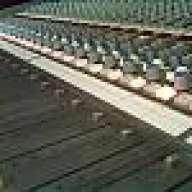
I've been told that to do this right you should not only listen to the frequency but look at the meter on your eq - I'm using an ssl as an example cause thats what I was shown on - but you find as you boost and then sweep through the general area the signal will only peak at certain areas - these are the ones to cut - bizarly they are often around 10% below the fundamental or integer harmonic - so are undertones or noise frequencies. (makes sense)

I've found that the q width on many plug ins is way too narrow and just causes self oscillation so when using plug ins I always try to open the Q a little - especially with waves - why the fuck you'd need a Q as narrow as 100 of an octave is beyond me - surely 1 /12th of an octave is the smallest you'll ever need?
 
Black neon bob said:
How do most of you feel about boosting EQ?

I do try to avoid it as much as possible but sometimes it just is not possible. For example on my OH's I usually have to High-self them a little. But most of the time I go for the subtractive method. If somthing is lacking clarity instead of going for the mid to high frequinces I try to cut what is masking that clarity.
 
moose209 said:
I agree that boosting in the high ranges is definately the sound of modern hats and cymbals. I've found that when I want to hear more sheen that I actually need to boost an octave below - I'm experimenting with this in other ranges but for example when I need to hear more brilliance say 8k I'll actually get a better result from either a little at 4 and a little at 8 or none at 8 and all at 4. How do people treat harmonics?

This is a technique that a lot of people pratice. I don't know if any of you know slipperman over at the marsh but he is preaching this over and over. If you hear something at 4000 cycles you like then there is a chance you might like something at 2000 cycles or 8000 cycles.
 
Benny H said:
'find the shitty frequency with a narrow bandwidth and maximum boost'

I find all frequencies sound shitty doing this. Is there something specific I should be listening for? Doesn't it more or less just tell you what there's more of, rather than what's shitty?

I guess you kinda gotta already know what it is you don't like.. but if that's the case, you should be able to use maximum cut and move it around until the nasty is gone. This is less confusing, as what you're hearing and judging things by is what it will sound like when you're done. Less fatiging also.

Also, if it's just showing that there's 'more', sometimes might not that frequency be integral to the character of something? I mean, this same technique is how you find the resonant freq. of the kick drum. It wouldn't be surprising that the life is gone if you're killing off what gives the sound it's character.


Yes and no. You have to have an idea as to what you are looking for. Take for example the guitars. A lot of us have problems with low-mids. So you would generally have a mid Q setup and boosted about so you can sweep in the low-mid area. As you sweep you listen. When you find the most offensive spot then that is were you want to cut. Narrow up the Q a little and cut a couple of dB.

As far as just slicing the hell out of it with 20 dB cuts. Thats not such a good idea in most cases. It subtracts other freq's that hold the life of the sound.